
Website traffic can tell you a lot about interest, but standard analytics usually stop short of showing who is actually behind those visits.
Visitor identification fills in more of that picture. Different platforms reveal different levels of detail, from company information and individual contacts to behavioral signals that can help you decide which visitors deserve more attention.
Capturify and RB2B both tackle that problem, but their products head in different directions after identification.
RB2B has a strong B2B sales focus and is known for surfacing person-level data from site visitors. Capturify covers B2B and B2C identification while connecting visitor data with intent targeting, advertising, CRM activity, and automated outreach.
So, which one fits your business better? In this Capturify vs RB2B comparison, we’ll look at their identification capabilities, features, intent data, pricing, and ideal use cases.
TL;DR
- RB2B vs. Capturify comes down to focus: RB2B is better suited to B2B sales teams that primarily want to identify website visitors and turn them into prospects, while Capturify supports broader B2B and B2C identification plus marketing and audience activation.
- RB2B emphasizes person-level identification, LinkedIn profiles, visitor activity, sales alerts, and integrations that help reps move warm website visitors into outbound workflows.
- RB2B’s standard person-level identification is focused on U.S. traffic, while its company-level identification offers broader geographic coverage.
- Capturify is the stronger fit for businesses that want to do more with identified traffic, combining B2B and B2C visitor identification with intent targeting, advertising activation, CRM integrations, retargeting, and automated outreach.
What Is a Visitor Identification Platform?
A visitor identification platform helps you learn more about anonymous website traffic that would normally disappear from view once someone leaves your site.
The information you receive depends on the platform and its available data sources. Some platforms may provide:
- Company data tied to the business visiting your site
- Person-level identification that connects activity with an individual
- Contact data, such as a business email or phone number
- Professional details, including job title or LinkedIn profile
- Visitor behavior, such as pages viewed or repeat visits
Identification becomes much more useful when paired with context.
Knowing a company visited your website may give a rep a reason to research the account. Seeing someone return repeatedly and view a high-intent page provides a stronger signal.
Marketing teams can use the same visitor data for audience building or retargeting.
For that reason, choosing visitor tracking software requires more than comparing how many visitors each product can identify. Data quality and the actionable insights you receive deserve equal attention.
Capturify vs. RB2B at a Glance
Both platforms help identify visitors, but their core use cases are noticeably different.
Here's how they differ at a high level:
- Capturify supports B2B and B2C identification. Businesses can connect anonymous traffic with marketing activity or sales follow-up.
- RB2B focuses heavily on B2B. Its platform centers on identifying professional website visitors and surfacing buying signals for sales teams.
- Capturify extends into audience activation. Intent data can feed advertising, CRM systems, and automation workflows.
- RB2B emphasizes sales action. Person-level data, LinkedIn profiles, page activity, and notifications can help reps find contacts worth pursuing.
- Geographic coverage differs. RB2B’s standard person-level resolution centers on US traffic, while its company-level identification has broader coverage.
Your best choice depends largely on what needs to happen once the visitor ID has been resolved. A team focused on direct outreach may have very different requirements from one using visitor intelligence throughout its sales funnel. More on this later.
How Capturify Approaches Visitor Identification
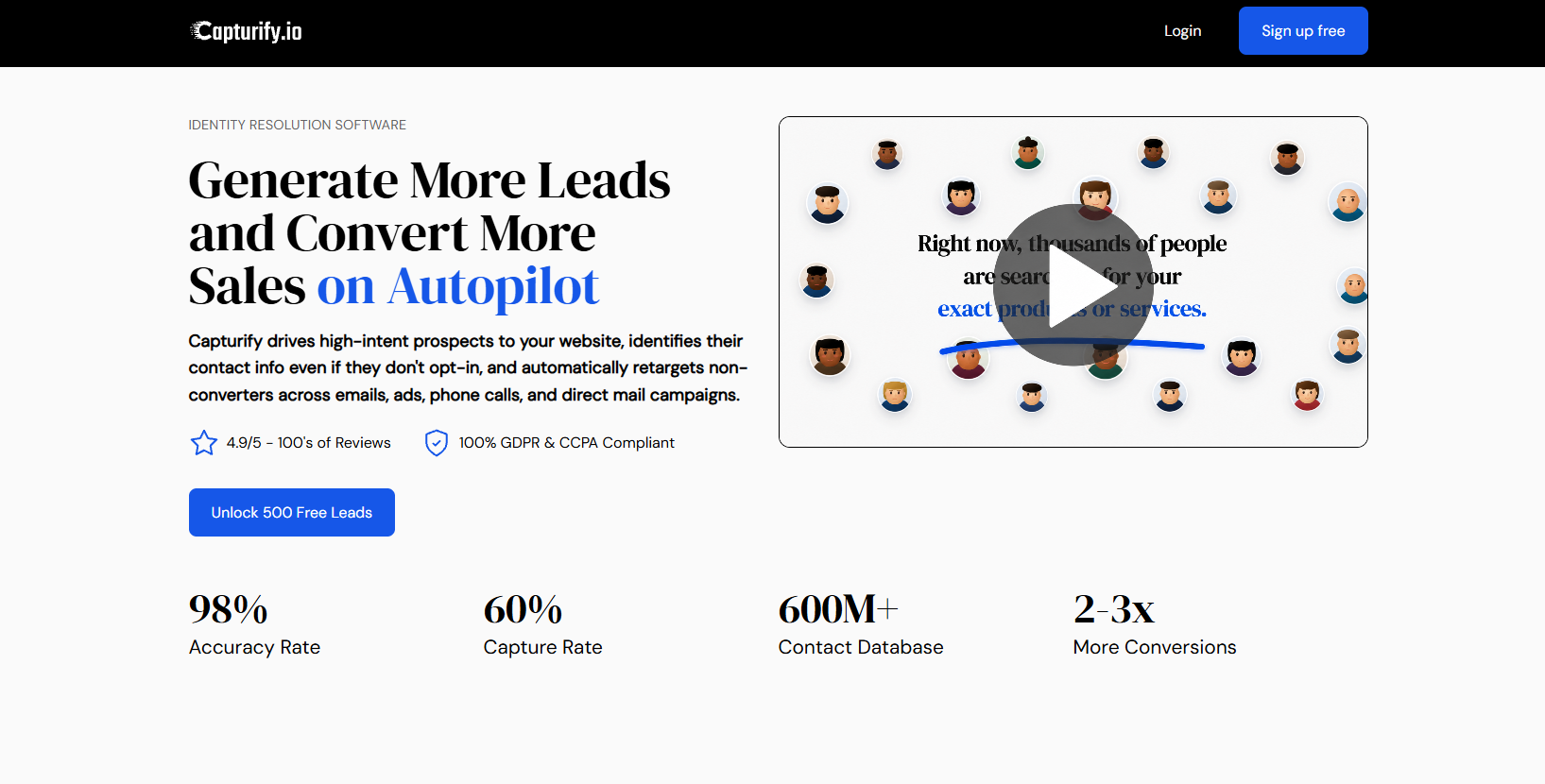
Capturify approaches visitor identification as one part of a broader customer acquisition system.
You install its tracking technology on your site, and the platform begins identifying anonymous visitors when matching data is available. Capturify's identified profiles can contain more than 40 data points. Those records can then feed other systems your business uses.
For a B2B team, lead identification could surface potential prospects for follow-up. For instance, a consumer brand might use the same technology to build audiences from shoppers who visited but did not purchase.
Capturify brings behavioral targeting into the picture too. Its intent targeting capabilities use recent online behavior to help businesses reach people showing interest in relevant topics.
The platform sits at the intersection of identification, intent data, and audience activation. Rather than treating a match as the end result, Capturify gives revenue teams several ways to use the data once a visitor has been recognized.
Try Capturify today and get up to 500 free leads.
How RB2B Approaches Visitor Identification
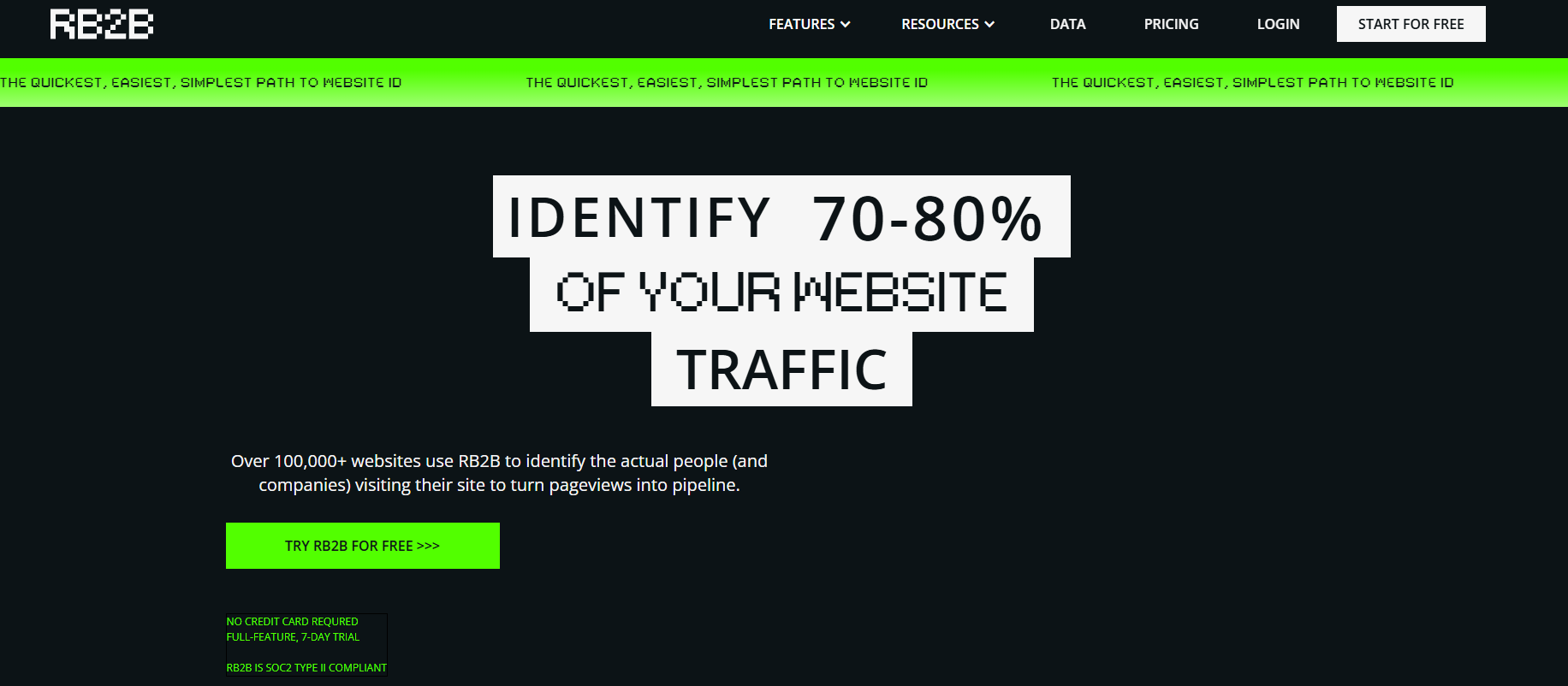
RB2B has a narrower B2B focus.
The platform identifies companies visiting your website and, on applicable paid plans, can reveal person-level information for matched visitors. Its standard contact-level identification is focused on US traffic, while company-level identification has broader geographic availability.
LinkedIn information is a prominent part of the product. When available, a rep can see the professional profile associated with a visitor and use it to understand who has been browsing the site.
RB2B then moves those intent signals toward sales activity.
For example, a rep might receive visitor information in Slack, review the pages visited, and decide if the contact belongs in an outbound sequence. Higher plans add business email addresses and more integrations.
The setup makes RB2B particularly relevant for B2B revenue teams that view website activity as a prospecting signal.
If person-level identification is your priority, though, keep the geographic limitation in mind. Standard identification is effectively US-only for contact-level matches.
Person-Level vs. Company-Level Identification
Company-level and person-level identification answer two different questions.
Company-level data tells you which organization appears to be behind a visit. You might learn that someone from a target account reached your site, but you may not know the individual researching your product.
Person-level data gets more specific. When a match is available, it may include information such as a visitor’s name, business contact details, job title, or LinkedIn profile.
RB2B makes the distinction clear through its plans. Its entry-level offering gives you company visibility, while paid plans add more detailed contact-level identification.
Capturify takes a broader identity resolution approach that can work with business and consumer traffic.
Neither method automatically gives you a qualified lead, however. Account-level information still needs context, and individual matches should be evaluated alongside visitor behavior.
Teams usually get the best results when identification helps answer a larger question: Is there enough evidence here to spend time on this prospect or audience?
Intent Data and Visitor Behavior
Identification tells you who may have visited. Behavioral and intent data can tell you much more about what they appear interested in.
Useful signals include:
- Pages visited: A visitor spending time on commercially important areas of your site may be showing stronger interest than someone reading a general article.
- Recent activity: Fresh behavior can give revenue teams a better idea of who is actively researching compared with a visitor whose last interaction happened months ago.
- Repeat visits: Multiple visits may suggest growing interest, particularly when the person starts moving deeper into your site.
- Topic-level intent: Capturify can use recent behavioral data to build audiences around people showing interest in relevant subjects beyond activity on your own website.
RB2B primarily uses visitor behavior to give sales teams context around potential leads.
Capturify goes further into audience creation and activation, which can be useful when marketing teams need to apply intent signals outside a traditional outbound workflow.
Capturify Features
Capturify combines identity resolution with tools for acting on the data you collect.
Its main capabilities include:
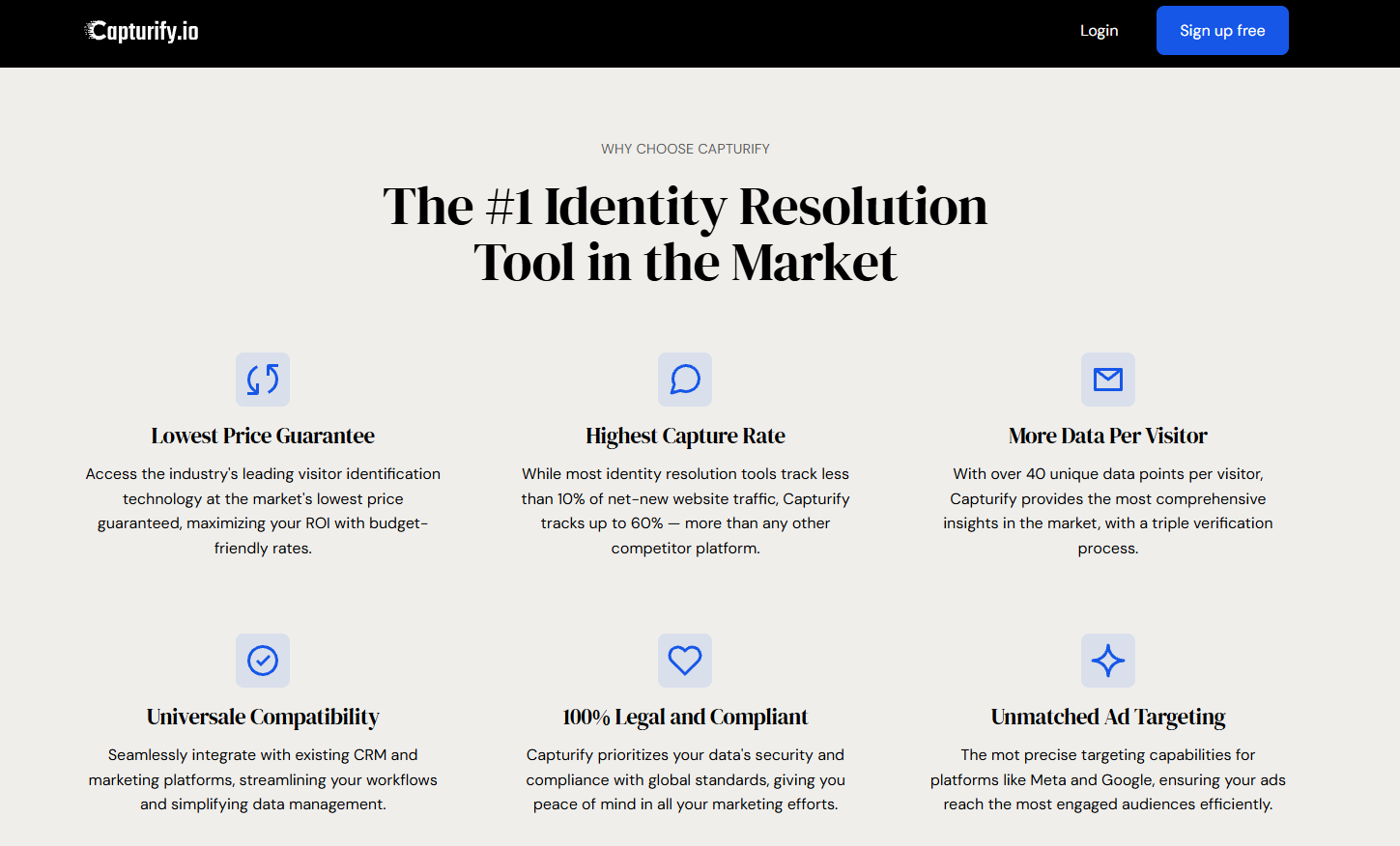
- Visitor identification: Capturify can identify anonymous website visitors and enrich matched profiles with more than 40 data points.
- Intent targeting: Businesses can build audiences around recent behavioral signals and thousands of interest categories, helping uncover potential buyers beyond existing site traffic.
- CRM sync: Visitor and lead data can connect with commonly used CRM and marketing systems so teams can move records into existing workflows.
- Advertising activation: Capturify supports audience activation through channels such as Meta and Google Ads.
- Automated outreach: Higher plans can use visitor demographics and online behavior to support personalized email follow-up.
- Additional activation options: Businesses can connect Capturify with other tools for outreach through channels like direct mail and phone.
The single platform approach is useful when identification feeds several parts of your customer acquisition strategy.
RB2B Features
RB2B concentrates its product around B2B visitor identification and sales activation.
Its main capabilities include:
- Company identification: RB2B can reveal companies visiting your website, which gives sales teams account-level information even when a specific individual cannot be identified.
- Person-level identification: Eligible plans provide contact-level details for matched U.S. visitors.
- LinkedIn profiles: Professional profiles can help reps research prospects before deciding how to approach them.
- Business contact information: Higher paid plans can provide details such as business email addresses when available.
- Hot Pages and Hot Leads: Teams can flag important pages and apply criteria that help separate general traffic from visitors who appear more relevant.
- Sales integrations: Paid plans provide more ways to push leads toward CRM systems and outbound sales tools.
RB2B’s higher-resolution offering combines multiple data sources through an identity graph to help increase the number of visitors it can potentially resolve.
B2B and B2C Use Cases
Your audience can quickly narrow the decision between Capturify and RB2B.
Capturify can support use cases such as:
- B2B lead identification and sales follow-up
- Ecommerce retargeting based on visitor behavior
- Consumer audience development for paid advertising
- Local or service-business lead generation
- Agency campaigns serving different audience types
RB2B is much more closely aligned with B2B use cases, including:
- Finding prospects visiting important website pages
- Alerting reps when target companies visit
- Using professional profiles to research potential contacts
- Account prioritization based on website activity
- Moving warm leads into outbound sequences
A SaaS team selling primarily to U.S. businesses may appreciate RB2B’s tighter sales focus.
On the other hand, Capturify makes more sense when your business serves consumers too, or when the same visitor data needs to support marketing campaigns alongside sales activity.
Multi-Channel Activation
Finding an identifiable visitor is only the beginning. You still need a useful place to send the data.
Capturify gives teams several options after identification. Visitor profiles can flow into a CRM, while audience data can connect with advertising platforms such as Meta and Google. Higher plans extend activation into email and other outreach channels.
A visitor showing strong interest, for example, could enter a retargeting audience rather than going directly to a salesperson.
RB2B follows a more sales-oriented path.
Identified visitors can appear in tools such as Slack or Teams, giving reps a signal while the account may still be actively researching. Higher plans can move those leads into CRM and outbound systems.
Consider how many other tools need access to your visitor data.
If identification primarily feeds sales reps, RB2B’s narrower workflow may be enough. Capturify gives you more flexibility when the data needs to move through several marketing and revenue workflows.
Book a demo now and see how Capturify works.
Capturify vs RB2B Pricing
Here are Capturify’s pricing plans:
- Identify: Starts at $97 per month and includes up to 500 lead captures with enriched visitor information.
- Accelerate: Starts at $197 per month and adds features related to intent targeting, geographic targeting, and advertising activation.
- Automate: Starts at $447 per month and expands into AI-personalized email and additional outreach integrations.
RB2B offers the following plans:
- Free: $0 per month with 150 monthly resolutions and company-level identification.
- Starter: $79 per month with 300 monthly resolutions and person-level identification for U.S. traffic.
- Pro: Starts at $149 per month and adds business email addresses plus more integrations.
- Pro+: Starts at $199 per month with Premium Resolution and higher identification coverage.
Pricing can rise with usage. Larger accounts may encounter custom pricing based on traffic volume, resolution needs, or other requirements, so teams expecting substantial volume should compare custom pricing before committing.
How the RB2B Pricing Model Scales
RB2B’s pricing is tied largely to monthly resolution volume.
Each identified visitor uses a resolution, and the number included depends on your plan. Starter includes 300 monthly resolutions, while Pro and Pro+ offer higher-volume options and additional capabilities.
RB2B also charges for overages on its paid plans, so exceeding your monthly allowance does not necessarily mean moving to another tier right away.
Traffic volume still plays an important role in estimating cost. A smaller B2B site may stay comfortably within one of the lower plans, while larger teams generating more identifiable traffic could use its included resolutions much faster.
Team size alone does not tell you much about what you will spend. Look at your website traffic, expected match volume, and how many identified visitors your team can realistically act on when comparing plans.
Match Rates and Data Coverage
Match-rate numbers can be useful, but they need some context.
RB2B’s Starter and Pro plans use Basic Resolution, which relies mainly on its internal identity graph and is optimized for U.S. traffic. RB2B says those plans typically identify around 30% to 40% of total traffic.
Pro+ uses Premium Resolution, which adds multiple data sources through external identity graphs. RB2B reports average identification rates of 70% to 80% on that plan, with broader international coverage as well.
Capturify has capture rates of up to 60%, depending on factors such as traffic quality and audience characteristics.
Raw percentages still do not tell you everything. Your geography and visitor mix can change the results considerably.
A lower match rate with accurate data may ultimately give your team more useful leads than a larger pool of records you cannot confidently act on.
Data Quality vs. Identification Volume
A high identification percentage has limited usefulness when the resulting records contain weak or inaccurate information. So, look closely at data quality before choosing a platform.
For a B2B sales team, accurate data may mean finding the right professional identity and enough company context to determine if the person belongs to a relevant account.
Marketing teams may care more about behavioral signals and the ability to organize identified visitors into useful audiences.
False matches can waste your team’s time. Poor contact data may also push leads into your CRM that never become meaningful opportunities.
Page context can make a big difference too.
Someone visiting a careers page may be identifiable, but their activity does not carry the same intent as a prospect repeatedly researching your product.
Better data should make prioritization easier. When comparing Capturify, RB2B, Lead Forensics, or other platforms, ask how much useful context comes with each match and how confidently your team can act on it.
How to Pick the Right Platform
Choosing between Capturify and RB2B is about more than their features. It also depends on what you’re trying to achieve.
Which Is Better for Sales Teams?
RB2B has an obvious appeal for sales teams that want a straightforward signal when prospects visit the website.
Reps can see identified contacts, review professional information, and use visitor activity to decide who deserves attention. Features such as Hot Pages and Hot Leads can help with account prioritization as traffic increases.
Those actionable insights can move into outbound sequences or other direct outreach while the prospect’s interest is relatively fresh.
Capturify gives sales teams lead identification capabilities too. Visitor records can move into a CRM, while intent data can help reps focus on potential buyers showing stronger interest.
The main difference is how far the platforms extend beyond sales.
RB2B feels closer to a dedicated prospecting tool designed to find contacts from your website.
Capturify may suit revenue teams that want sales intelligence connected with marketing campaigns and other parts of the sales funnel through one system.
Which Is Better for Marketing Teams?
Marketing teams often need visitor data to do something other than trigger a sales notification.
Capturify has the stronger positioning here because audience activation is a central part of its platform.
Identified visitors and intent audiences can connect with Meta and Google advertising, while CRM integrations help move lead data into existing campaigns. Businesses can then use those audiences for retargeting or broader acquisition efforts.
The result is a workflow where anonymous traffic can influence future marketing rather than disappearing once the visitor leaves your site.
RB2B can still give marketers useful information about the businesses and people reaching the website. Visitor behavior can help evaluate traffic quality and indicate which campaigns attract relevant prospects.
Its core activation model remains much more closely connected with sales.
For marketing teams focused heavily on paid media or audience development, Capturify provides more options for applying visitor intelligence after the initial identification.
Which Is Better for eCommerce and B2C?
Capturify is the clearer fit when consumer traffic represents a meaningful part of your audience.
RB2B’s person-level product centers on professional B2B traffic in the U.S. LinkedIn profiles and business email information make sense when your next move is reaching someone in a professional context.
Those signals are less relevant for a typical online shopper.
Capturify supports consumer-focused identity resolution and connects behavioral intent with audience targeting.
An eCommerce brand could use intent information to reach people researching products related to its category, identify visitors once they reach the site, and continue engaging useful audiences through advertising.
A service company could use a similar strategy for lead generation.
The distinction becomes important for businesses with a hybrid model as well. If both business buyers and consumers contribute meaningful revenue, maintaining a visitor identification strategy that can cover both audiences may be easier than relying on separate platforms for each side.
Easy Setup and Integrations
Implementation can turn a promising platform into a frustrating one if your team has trouble getting data where it needs to go.
Both Capturify and RB2B are designed for relatively easy setup.
Capturify uses website tracking technology to begin capturing visitor information and connects with systems used for CRM, marketing, and advertising. Those integrations help teams push leads or audiences into existing workflows rather than rebuilding their process around a new tool.
RB2B provides a similarly simple starting point. Teams can send identified visitor activity into Slack or Teams, which gives smaller organizations an accessible way to test the platform.
Higher RB2B plans open more integrations for CRM and outbound activity.
Your existing technology stack should influence the decision.
Limited integrations may be perfectly acceptable when a rep only needs a visitor alert. Integration depth becomes much more important when multiple departments need the same visitor data or when automated workflows depend on information moving between several systems.
Capturify vs RB2B: Which One Should You Choose?
Capturify and RB2B begin with the same basic opportunity: turning anonymous traffic into information you can use.
RB2B is a compelling choice for B2B sales teams that want to identify companies and individual prospects visiting their website. Its person-level resolution, professional profiles, sales notifications, and outbound integrations keep the experience closely aligned with prospecting.
Capturify covers a broader range of use cases.
The platform can identify B2B and B2C visitors, enrich those profiles, connect intent signals with audience targeting, and move resulting data into both marketing and sales workflows.
Ask yourself where your visitor data needs to go after identification.
If the answer is mainly your sales team, RB2B offers a focused workflow.
If you want a single platform connecting visitor intelligence with advertising, CRM activity, retargeting, and follow-up, Capturify gives you more ways to turn website interest into future opportunities.
Put More of Your Traffic to Work With Capturify
Ultimately, the better platform comes down to how far you want to take visitor data after identification.
Capturify gives you room to move beyond basic alerts and use identified visitors for audience building, retargeting, and follow-up across your existing marketing and sales channels.
If you want to see how that looks with your own traffic, try Capturify and get up to 500 free leads.
FAQs About RB2B vs. Capturify
What are some alternatives to RB2B?
Capturify is an RB2B alternative for businesses that want visitor identification alongside B2C support, intent targeting, advertising activation, and broader automation. Other tools in the market include Lead Forensics, Warmly, and Factors.ai. The best fit depends on what you need from the platform, such as person-level information, company identification, behavioral intent, or multi-channel activation.
Is RB2B good for small teams?
RB2B can work well for small teams that want a simple way to identify high-intent accounts and turn website activity into a more useful lead list. Its focus on visitor alerts and sales signals can provide lightweight revenue intelligence without requiring a large tech stack. Teams looking for broader features such as AI agents, AI chat, or LinkedIn Ads activation may need other tools alongside it, since those are not the main focus of RB2B.
Which companies currently use RB2B?
RB2B has published customer examples and testimonials from businesses such as Mixmax, Reply, Sendspark, Default, and Biscred. Their use cases generally involve finding prospects already showing interest through website activity and helping sales reps decide which visitors deserve follow-up.
What are the benefits of RB2B?
RB2B can help sales teams uncover warm leads that are already interacting with their website. Depending on the plan, users can access company- or person-level identification, professional profiles, business contact information, and real-time visitor alerts. Those insights can make account prioritization easier and provide useful context before outreach. Paid plans add integrations that help push leads into existing CRM and sales workflows.